How to Navigate Uncertainty: An Unexpected Lesson from Improv
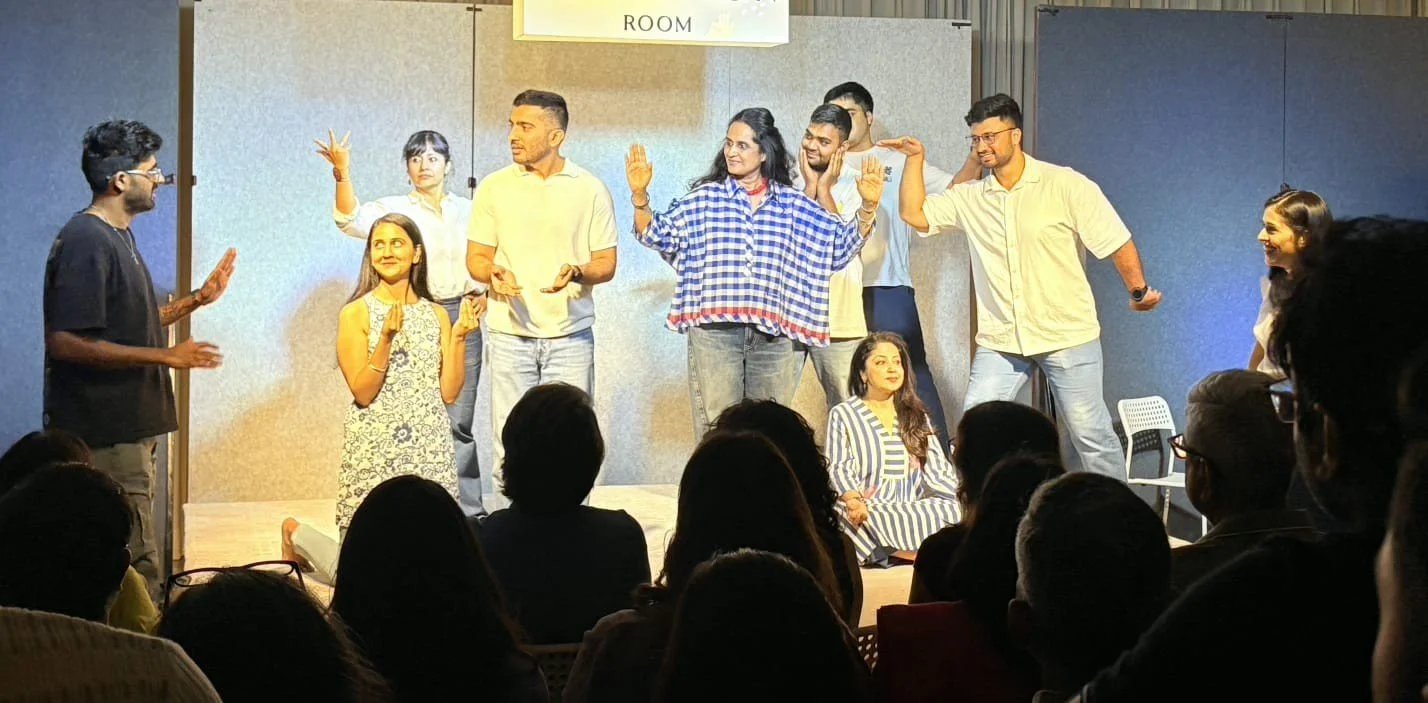
Our team on stage during our Improv showcase
Last month, I finished Level 2 of Improv.
If you had asked me last year whether I'd be open to committing every weekend to an activity that required me to step out of the house at 10 am, you would have gotten a resounding no.
Yet here I am, five months in.
While it is fun, it also continues to be a great mirror for life, and for how I participate in it.
For the uninitiated, improv is unscripted theatre where performers co-create scenes, characters, and stories on the spot based on a suggestion from the audience. (Or you might have seen it in the famous TV show "Whose Line Is It Anyway?")
For the same audience suggestion, I may have a scene and character in mind, while my partner may have something completely different. Depending on how they respond to what I say, I constantly need to let go of what I originally had in mind and take the scene forward based on what they offer.
(And it may still not be how they expected me to respond, so they are constantly letting go too.)
This is one of the first lessons you learn: how to be flexible and practice letting go. Improv becomes a tiny sandbox: a staging environment for life.
Because we are almost always improvising, both in life and as leaders. Situations change, people bring unexpected perspectives, and there is no script.
Initially, I felt I was doing quite well. I was able to take scenes forward from the very beginning. After all, I had already practiced "letting go" through different experiences in life.
But the deeper realization came when our teacher pointed out that the easiest (read cop-out) way to move a scene forward is often by negating your partner's offer or getting into conflict with them. We started noticing we can’t really take the scene forward for long if we do that, we would just be circling around.
In improv, an "offer" is what someone brings into the scene…the reality they're proposing. And when we don't accept that offer, the scene becomes harder to build together.
It was amusing to realize that even when we are letting go, we may still not be open to what is being offered to us.
Maybe because it is very different from what we had in mind.
Maybe because we still think our idea was better.
Or maybe because we are judging how we are looking to the audience, or the world.
And underneath that resistance is often a desire to prevent the scene from going badly, or to prevent ourselves from looking bad.
In other words, a fear of failure.
I see this show up often in interpersonal relationships. We genuinely want the relationship to work. We may even be willing to let go of our ideas. Yet we still find ourselves in conflict, or the relationship doesn't flourish the way we hoped it would.
Sometimes I think this is true in our relationship with life itself as well, or with the world, the universe, or God…however you see it.
Improv has become a conduit for me to practice something deeper: the ability to truly go with the flow. To practice saying "yes" to reality and then choosing what I want to create with it. (While the movie "Yes Man" wasn't inspired by improv, it heavily features the core philosophy of improv, and many of the scenes were improvised as well.)
I'm not yet at a place where I would say "yes” (or "Yes, and," as they call it in improv) to everything. But I am learning to reinforce the trust that I'll be there for myself, no matter what comes.
I don't need to have a plan for everything. And I don't need to panic when things don't go according to plan. Not just for bigger things, but even smaller ones. Because no matter how hard we try, we can’t stop bad things from happening.
Instead, if I am listening closely and paying attention to what is being asked of me in this moment, perhaps I'll be able to respond with openness even to the hardest parts.
And that reminds me of something I recently read from Oliver Burkeman:
"In the end, I suppose that this unclenched approach to life works because it reflects how things actually are. We all are freewriting our lives inevitably, whether we like it or not. Even the most hidebound plan-maker and routine-follower is still choosing, again and again, to keep following those plans and routines, in each new moment that arises. And even the most anxious worrier, forever trying to rule out future uncertainties, remains subject to the fundamental truth that anything could happen at any moment."
Reflect: What is life offering you right now that you're still resisting because it wasn't part of your plan?
If you’d like to read more from me like this directly in your inbox, you can head hereto subscribe to my newsletter.