What Most People Get Wrong About Happiness and Fulfilment
Most career transitions don’t fail because of a lack of options.
They fail because we aren’t ready internally, to take the journey.
In my transition coaching engagements, most of the work happens on the inside. On helping people prepare for the uncertainty, the fear of the unknown, and the difficulty of letting go of the good parts of “what is.”
That inner readiness is often what determines whether someone moves forward, or stays stuck.
The question I find myself asking most often is this:
“What costs or consequences are you willing to face to get what you want?”
Because sometimes, we think we want something but we don’t want it enough to go through the struggle it demands.
There’s a difference between wanting something and liking the idea of wanting it, without wanting the discomfort that comes with it.
That discomfort may look like:
putting yourself out there and being okay with rejection
trying something new and being willing to fail
accepting slower financial growth for a while
When we’re unwilling to sacrifice anything, we often end up feeling stuck and even miserable.
That’s why the question “What are you willing to struggle for?” matters so much (credit: Mark Manson).
And this isn’t just true for careers. It applies to life itself.
Happiness and fulfilment require struggle.
There’s a famous case study from the 1950s where a cake premix failed, even though the cake tasted great and all one had to do was add water.
The reason? People felt guilty that it was too easy.
When the company changed the recipe to require the addition of one egg, sales soared. That small effort transformed a shortcut into a meaningful experience.
While this was a marketing move, it also reveals something deeper: effort gives meaning to our experiences.
In The How of Happiness, Sonja Lyubomirsky explains what happiness is shaped by:
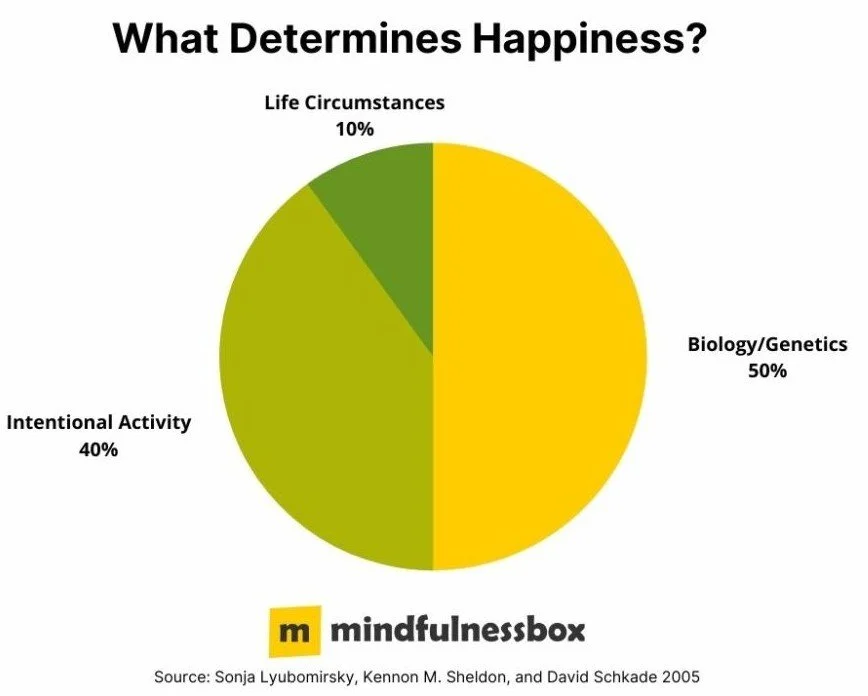
The reason circumstances matter so little is hedonic adaptation. We quickly get used to new situations, whether they’re positive or negative.
Which means trying to be happy by changing external conditions alone (without intentional effort) doesn’t work long-term.
It may help, for a while.
But not for long.
This is why “I’ll be happy when/if…” is largely a myth.
We don’t get lasting fulfilment by waiting for life to align.
We get it by engaging, choosing effort, and working through difficulty.
This can look like:
not taking our marriages for granted
continuing to learn and stretch even after landing our dream jobs
recognizing that adaptation is inevitable, and effort must be ongoing
Positive experiences are relatively easy to handle: they’re fleeting delights, often dependent on things going our way.
Negative experiences, on the other hand, can only be avoided for so long. They surface more sharply because of adaptation or social comparison.
So the real skill in life is learning how to deal with them, through intentional effort.
When we accept that struggle is part of the path, and that effort is what leads us to meaning, life becomes easier to navigate.
And when things do go our way?
They become the cherry on top.
Ultimately, what we get out of life isn’t determined by the good feelings we want but by the struggles we’re willing to sustain to reach them.
So here’s a question to sit with:
What effort or struggle would you like to choose this year?
If you’d like to read more from me like this directly in your inbox, you can head here to subscribe to my newsletter.